
What Big Four Consultant Cliff Edge Means For Us
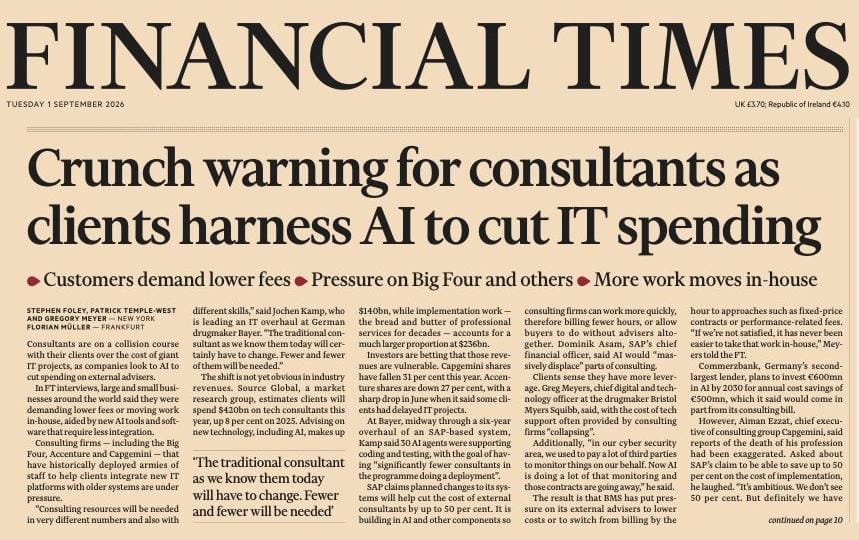
Here's a screenshot of the FT splash 1 Sep '26. Ouch, that pull quote;
"The traditional consultant as we know them today will have to change. Fewer and fewer will be needed."
Not many a tear shed, I grant you.
Then behind the gleeful comeuppance many a buyer might take, see also;
"Crunch warning"
"Customers demand lower fees"
"More work moves in-house"
Yes, we can rail with the ol' barb;
"Every Big Consulting Partner proudly has a yacht called Change Order".
The article itself [sub'n req'd] features a bazaar of bluechip buyers that are slashing their consultant spend. Joyful in recounting how a fraction of released spend happily replaces what was previously supplied (at, by inference, now judged rip-off rates).
We might rejoice that Fortune500 C-Suite leaders are bringing back many tasks through deploying AI. The piece mentioned at least eight prime corporate project areas; system integration, content creation, program implementation, security monitoring, change management, infrastructure audits, demand analysis, market research.
And here's one killer citation that'll shiver many a client of these services timbers;
But there are benefits beyond simple cost savings. [One Big Bank] also “often found that [consultants] learn more from us than we learn from them”, ... meaning the bank keeps a competitive edge by doing more in-house.
Shipbuilders won't be best pleased though, hey.
But might we soon be in their boat?
As this is surely moving closer to home. For the AI seism that brings about this welcome 'professional services' correction actually brings a tsunami now racing many a solution seller's way.
Those of us that pitch what might once have been termed our code or brains at any rate.
Will we see the same divide for instance, as that commonplace 90s insistence by chief bean counters that they could do whatever it was we offered in this regard themselves?
Their fiefdom included IT back then. Which couldn't help itself but grow through the hiring of all sorts of 'specialist' must-have resource.
The conversations I had back then in offices bedecked in murks of brown;
"are you now software developers then or, yunno, sticking to the day job?"
Maybe they'd like to also move into whatever else they felt adjacent to their line of business. Yet strangely, no manufacturer bought a load of lorries to ferry their wares on. No wholesaler opened up their own shops on the High Street.
Perhaps it's apt to recall what made threatened B2B suppliers adapt and succeed "last time 'round".
Whether enterprise-grade 'app' or 'knowhow' vendors, one key point of off-the-shelf variants is that clients tap into the knowledge of people who do this everyday; 'you buy once in a blue moon, I help people buy everyday...' And their experience of growth from people solving the self-same issues all the time can prove invaluable.
From the undisrupted supply in times of client staff upheaval, to removing SPoF (single point of failure). Ending reliance on a sole and possibly not omniscient source for the work, to building on the shoulders of all those traversing that landscape before, now and after.
For sure, downward cost pressure will feel crushing. But we have got to where we are for a reason. We must remind our would-be clients that. After all, how about another fruitful handle used three decades ago from the school of FUD;
"let's imagine if something were to go wrong with your own efforts..."